Aggregate is the least discussed material on a construction site and the one that most determines whether what sits on top of it lasts. Almost every asphalt and concrete failure traces back to what is underneath.
Yet aggregate is frequently ordered by whatever it was called last time. Here is what crusher run actually is, how it differs from the alternatives, and how to specify and quantify it properly.
What Crusher Run Actually Is
Crusher run is crushed stone that has not been screened to remove the fines. It contains everything from the largest specified particle size down to stone dust.
That combination is the entire point. The larger particles interlock to carry load, and the fines fill the spaces between them, so the material compacts to a dense, stable mass.
Screened or washed stone behaves completely differently. With the fines removed, particles cannot lock together the same way, so the material stays loose and drains freely.
This is the distinction that matters. Crusher run is a compacting material for structural base. Clean stone is a draining material for drainage applications. Substituting one for the other causes problems in both directions.
Base And Subbase Are Not The Same
Understanding the layers explains why more than one product is usually required.
Subgrade is the existing soil, prepared and compacted. It is not imported material.
Subbase sits above it and typically uses coarser, less expensive aggregate to build depth and provide separation from the soil.
Base is the layer directly beneath the pavement and requires better quality, well graded material, properly compacted. This is where crusher run is most commonly used.
Skipping the subbase and building depth entirely from base material works but costs more than necessary. Skipping the base and paving over coarse subbase material is the more common and more expensive error.
Gradation Decides Compaction
Gradation means the distribution of particle sizes, and it is the property that determines whether material compacts properly.
Well graded material contains a continuous range of sizes, so voids are filled progressively and the result is dense and stable.
Gap graded material is missing intermediate sizes, so it cannot fill voids properly and compaction suffers.
Uniformly graded material is mostly one size, which does not interlock and stays loose.
This is why two loads described identically can perform very differently. Ask for gradation information rather than only a product name, particularly on specified work.
Moisture matters too. Aggregate compacts best near its optimum moisture content. Too dry and particles will not seat, too wet and it becomes unstable, which is worth planning for in an Oklahoma summer.
The Products You Will Encounter
Crusher run in various maximum sizes, for structural base.
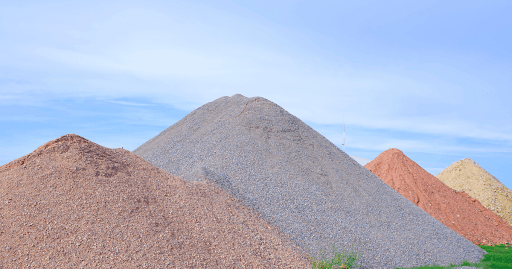
Screened or washed stone in single sizes, for drainage, pipe bedding and applications where free drainage matters.
Sand and fine aggregate, for bedding and backfill.
Recycled concrete aggregate, which performs well in many base applications, is generally less expensive and is worth asking about where the specification allows it.
Riprap and larger stone for erosion control and slope protection.
Product naming varies between suppliers and regions, which is exactly why gradation and specification matter more than the name. Confirming against a supplier's published product range avoids ordering the wrong thing under a familiar label.
How To Quantify What You Need
Calculate volume in cubic yards from the area and the compacted depth, then convert to tons, since aggregate is normally sold by weight.
The conversion depends on the material and its density, so ask the supplier for the appropriate factor rather than using a general figure.
Then account for compaction. Material loses volume as it compacts, so loose volume delivered exceeds compacted volume in place, commonly by a meaningful margin. Ordering to compacted volume without allowing for this leaves you short.
Add a contingency for uneven subgrade, spillage and losses. Running short mid placement costs considerably more than a small overage.
Confirm delivery capability against your site access. Truck size, turning space and where material can be stockpiled all matter, and discovering a constraint on delivery day is expensive.
What To Ask A Supplier
Which product meets the specification for my application, and can you provide gradation information.
Is the material available now or does it require production time.
What is the minimum order and how is it priced, by the ton or by the load.
Do you deliver, and what truck configurations can reach my site.
What conversion factor should I use for this material to calculate tonnage.
And can you supply both aggregate and asphalt if the project needs both. Coordinating base and surface material from a single local supplier simplifies scheduling considerably on projects where the base goes in one week and paving follows the next.
Frequently Asked Questions
What is crusher run used for?
Structural base beneath asphalt, concrete, driveways and similar surfaces. It contains particles from the maximum specified size down to stone dust, so the larger pieces interlock while fines fill the voids, producing a dense and stable compacted layer.
What is the difference between crusher run and washed stone?
Crusher run retains its fines, which allows it to compact into a dense structural layer. Washed or screened stone has the fines removed, so it drains freely but does not compact the same way. They suit different applications and should not be substituted.
How do I calculate how much aggregate I need?
Work out volume in cubic yards from area and compacted depth, then convert to tons using the density factor for that specific material, which the supplier can provide. Add allowance for compaction losses and a contingency for uneven subgrade and spillage.
Why does gradation matter in base aggregate?
Because it determines whether material compacts properly. Well graded aggregate with a continuous range of particle sizes fills voids progressively and compacts densely. Material missing intermediate sizes cannot fill voids and compacts poorly, which weakens everything above it.
Can recycled concrete be used as base material?
In many applications yes, and it frequently performs well while costing less than virgin aggregate. Whether it is permitted depends on the project specification, so confirm the requirement before ordering and ask the supplier what recycled products they carry.

Trinitas Materials
Hot-mix asphalt & aggregates, Oklahoma City